
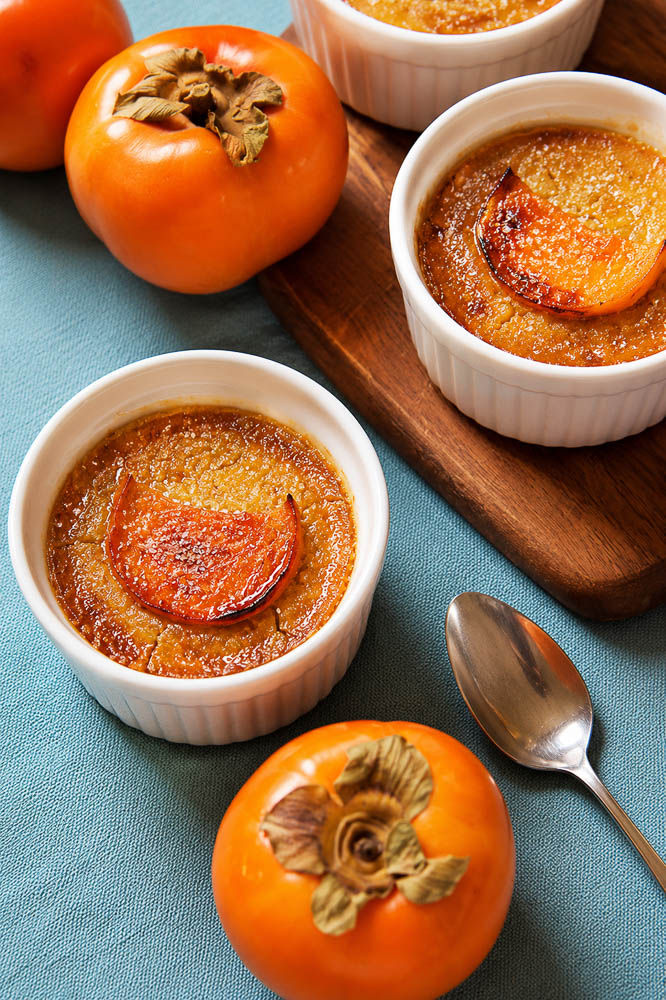
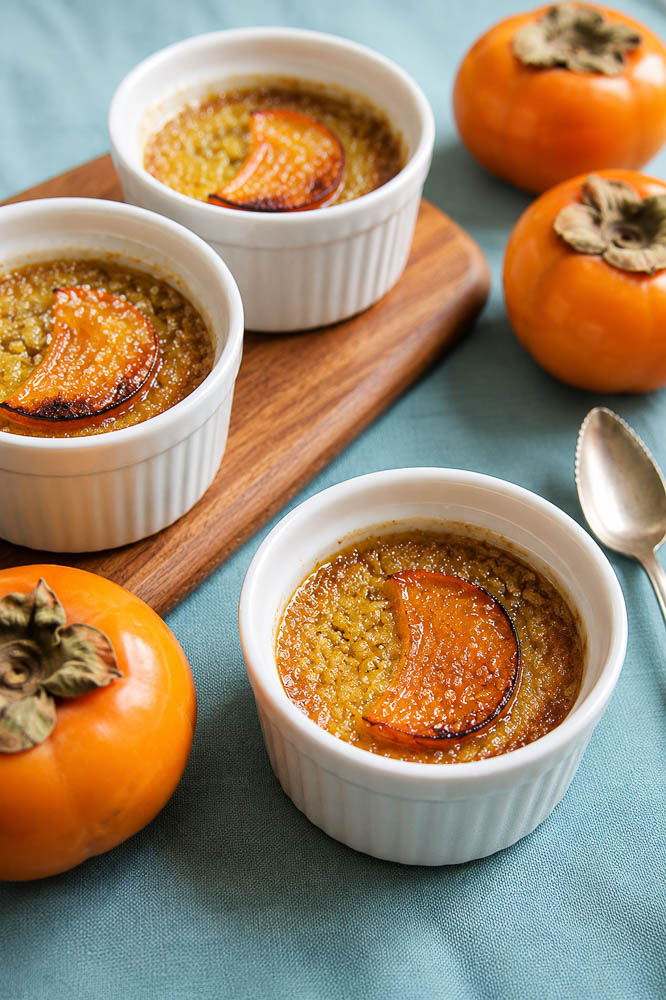
This Persimmon Crème Brûlée combines silky vanilla custard with the delicate sweetness of ripe persimmons, then finishes each ramekin with the crisp caramelized sugar shell that makes crème brûlée irresistible. The persimmon adds a subtle fruity flavor without overpowering the classic custard, making this an elegant make-ahead dessert for fall dinners, Thanksgiving, and holiday entertaining.
There are plenty of desserts competing for attention once fall arrives. Pumpkin gets most of the glory. Apples are everywhere. Pears quietly do their thing in the background.
And then there are persimmons.
Every year, I see those beautiful orange fruits appear at the market and remember how much I love them. When perfectly ripe, persimmons are naturally sweet, soft, and almost honey-like, which makes them especially good in desserts that don’t need a lot of extra sugar.
This Persimmon Crème Brûlée might be one of my favorite ways to use them.
At first glance, it looks like a classic crème brûlée. You still get that impossibly smooth custard underneath a thin layer of caramelized sugar, and yes, you still get the deeply satisfying moment when the spoon cracks through the top.
But underneath that familiar caramel shell is a custard subtly flavored with ripe persimmon. It isn’t aggressively fruity, and it certainly doesn’t taste like someone dropped fruit salad into your crème brûlée. The persimmon simply adds gentle sweetness and a soft autumn flavor that works beautifully with cream and vanilla. Basically, it’s classic crème brûlée wearing its fall sweater.
What Does Persimmon Crème Brûlée Taste Like?
Persimmons have a delicate flavor, which is exactly why they work so well in a creamy custard.
A very ripe persimmon tastes naturally sweet with notes that can feel almost honeyed, slightly floral, and gently fruity. Once blended with warm cream and vanilla, that flavor becomes even softer.
The finished custard still tastes unmistakably like crème brûlée. You get rich cream, vanilla, egg yolks, and caramelized sugar first, with persimmon showing up quietly underneath rather than demanding all the attention.
And then there is the caramel topping. That thin sheet of burnt sugar adds a slightly bitter, toasted flavor that balances the richness of the custard and the sweetness of the fruit.
It’s sweet without becoming sugary, rich without feeling excessively heavy, and unmistakably fall without requiring a single teaspoon of pumpkin spice.
The Texture Is Everything
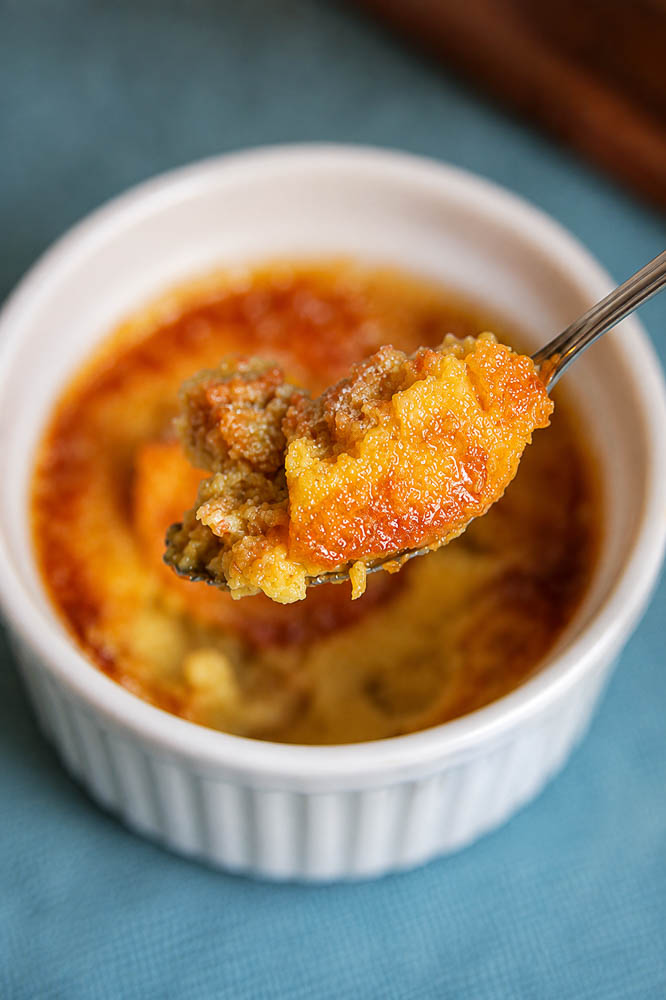
A good crème brûlée should be silky rather than firm. When you scoop into it, the custard should hold its shape while still feeling soft and creamy on the spoon. The persimmon blends directly into the cream, so you aren’t looking for chunks of fruit or a pulpy texture.
That’s why I like blending the cream mixture until completely smooth and then passing it through a fine-mesh strainer. Technically, you can skip the straining step. But if you want that luxurious restaurant-style texture, I wouldn’t.
Then, of course, you have the complete opposite texture sitting right on top.
Smooth custard underneath. Crisp caramel above.
The first crack through that sugar shell is half the reason crème brûlée exists.
Choosing the Best Persimmons
Persimmons can be slightly confusing if you didn’t grow up eating them because different varieties behave very differently.
Fuyu persimmons are squat and round, almost like tomatoes, and can be eaten while still fairly firm. For this recipe, though, I’d still let them become nicely ripe so their flavor is sweeter and easier to blend.
Hachiya persimmons are more elongated and must be completely ripe before eating. When ripe, they become extremely soft and almost custard-like inside.
An underripe Hachiya is a culinary betrayal. Its astringency will immediately dry out your mouth and make you question your life choices.
For crème brûlée, you want fruit that is soft, sweet, and fully ripe regardless of which variety you choose.
Why Persimmons Work So Well in Custard
Persimmons already have a naturally smooth, almost creamy quality when ripe, so blending them into a custard feels surprisingly natural. They also aren’t particularly acidic, which means they pair with cream much more gently than sharper fruits might.
Instead of cutting through the dairy, persimmon seems to settle into it. Vanilla enhances the fruit’s natural sweetness, while the caramelized sugar provides enough bitterness to keep the dessert balanced. It’s one of those combinations that feels obvious after you’ve tasted it.
Why the Water Bath Matters
The water bath may feel like an extra step, but it is doing important work behind the scenes.
Custards prefer gentle, even heat. Surrounding the ramekins with hot water protects the edges from becoming overcooked while the centers slowly set.
Without that buffer, you risk ending up with firm edges while the middle is still undercooked.
The key is also knowing when to stop baking. The outside should look set, but the center should still have a slight jiggle when you gently move the ramekin.
If it looks completely firm in the oven, it has probably gone a little too far. The custard continues setting as it cools.

The Best Part: Cracking the Caramel
You can prepare crème brûlée ahead.
You can chill it overnight.
You can beautifully garnish the plate.
But none of that matters until you caramelize the sugar.
Sprinkle a thin, even layer of granulated sugar over the chilled custard, then use a kitchen torch to melt it until bubbling and deeply golden.
Give it a minute to cool, and the melted sugar hardens into that signature glass-like shell. Then comes the important part. Tap it with a spoon.
Crack.
Still satisfying every single time.
A kitchen torch gives you the most control because you can caramelize the sugar quickly without warming the custard too much. A broiler can work in an emergency, but crème brûlée under a broiler requires your undivided attention. Sugar goes from beautifully bronzed to crime scene remarkably quickly.
Why This Is Perfect for Entertaining
Crème brûlée has a little secret. It looks like a dessert that requires restaurant-level timing, but most of the work can be finished well before your guests arrive.
The custards can be made up to two days ahead and kept refrigerated. When dessert time comes, all you need to do is sprinkle on the sugar and torch the tops.
That’s it. Nobody needs to know your impressive dessert has been patiently sitting in the refrigerator since yesterday.
For Thanksgiving especially, I consider that a major advantage because the oven already has enough responsibilities.
Serving Ideas
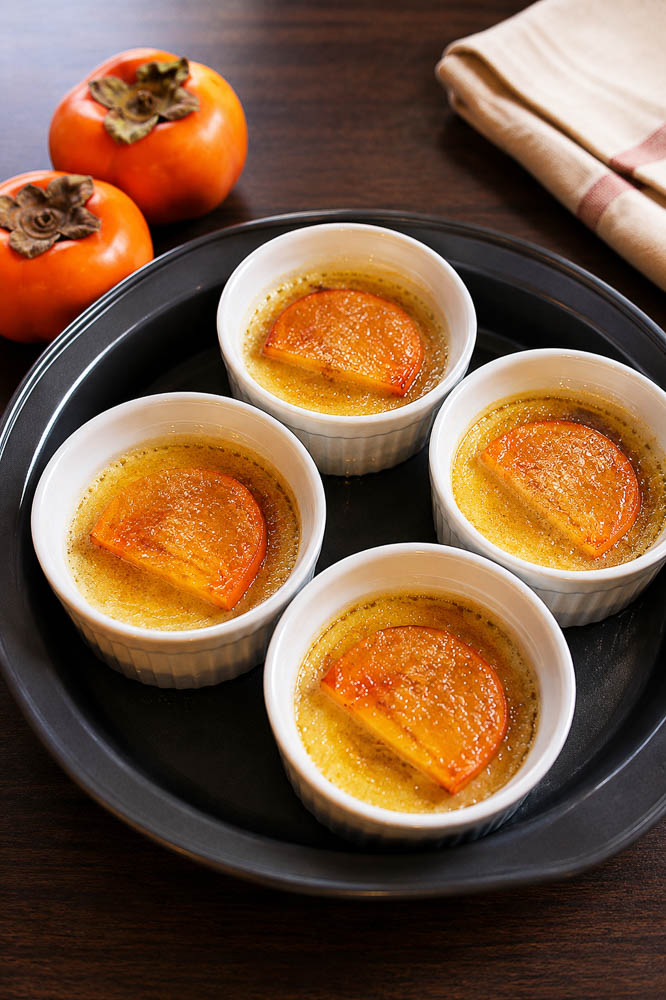
Persimmon Crème Brûlée really doesn’t need much decoration. A thin slice of fresh persimmon can look beautiful on the side, although I would avoid putting anything moist directly on top of the caramel shell because moisture is the enemy of crunch.
For fall entertaining, you could also serve it alongside coffee, espresso, or tea after dinner.
If you’re putting together a larger dessert table, I like the idea of letting this be the elegant, creamy option next to cookies, cakes, or fruit desserts with more texture.
And please don’t cover that caramel top with whipped cream. We worked hard for the crack. Let the crack have its moment.
Can I Make Persimmon Crème Brûlée Ahead?
Absolutely, and you should.
Prepare and bake the custards, allow them to cool, then refrigerate them covered for up to two days.
Do not brûlée the sugar until shortly before serving.
Once caramelized sugar sits in the refrigerator, it gradually absorbs moisture and loses that crisp texture.
The custard loves the refrigerator. The caramel does not. They need separate schedules.
FAQ
Can I use either Fuyu or Hachiya persimmons?
Yes. Both can work, but use fully ripe fruit. Hachiya persimmons in particular must be extremely ripe and soft because underripe fruit can be very astringent.
Does Persimmon Crème Brûlée taste strongly like persimmon?
No. The fruit flavor is deliberately subtle. The dessert still tastes primarily like classic vanilla crème brûlée, with gentle sweetness and fruitiness from the persimmon.
Why is my crème brûlée grainy?
Graininess usually means the eggs became too hot or the custard was overbaked. Temper the egg yolks slowly with the warm cream and bake just until the centers have a slight jiggle.
Can I make crème brûlée without a kitchen torch?
You can use a broiler, although a torch gives you much more control. Place the chilled ramekins close to the broiler and watch constantly because the sugar caramelizes very quickly.
How do I know when crème brûlée is done?
The edges should be set while the center still moves slightly when gently shaken. The custard will continue setting as it cools.
How far ahead can I make it?
The custard can be prepared up to two days before serving. Add and caramelize the sugar shortly before serving for the crispest topping.
A Little Catch-Up Before You Go
There is something about crème brûlée that will always feel slightly fancy to me.
Maybe it’s the individual ramekins.
Maybe it’s the kitchen torch.
Or maybe it’s because any dessert that requires you to deliberately break something before eating it automatically feels more exciting.
Adding persimmons makes this version feel especially right for fall. They give the custard a beautiful seasonal personality without changing everything I already love about classic crème brûlée. Underneath that crackly caramel top is still the same cool, silky custard, only now there is a little ripe persimmon hiding in every spoonful.
Pumpkin can have October. Persimmon is coming for November. Thanks for catching up with me.
Originally published in 2014. Updated in 2026 with new photos, improved instructions, and additional cooking tips.
Persimmon Creme Brulee
Ingredients
- 1 cup heavy cream
- 1/2 teaspoon vanilla extract
- 2 small ripe persimmons peeled and cubed
- 4 large egg yolks
- 3 tablespoons granulated sugar
- Pinch of salt
- 4 teaspoons granulated sugar for brûlée topping
Instructions
- Combine the heavy cream, vanilla, and persimmons in a medium saucepan. Heat over medium heat until the cream just begins to simmer. Do not boil.
- Remove from the heat and let cool for about 15 minutes. Transfer the mixture to a blender or food processor and blend until completely smooth.
- Preheat the oven to 300°F. Arrange four 6-ounce ramekins in a roasting pan or deep baking dish.
- In a medium bowl, whisk the egg yolks, 3 tablespoons sugar, and salt until smooth.
- Slowly pour the warm persimmon cream into the egg yolks while whisking constantly.
- For an extra-smooth custard, pour the mixture through a fine-mesh strainer into a measuring cup or bowl.
- Divide the custard evenly among the ramekins.
- Place the roasting pan on the middle oven rack. Carefully pour hot water into the pan until it reaches about halfway up the sides of the ramekins.
- Bake for 35–40 minutes, or until the edges are set but the centers still have a slight jiggle.
- Carefully remove the ramekins from the water bath and let cool to room temperature. Cover and refrigerate for at least 2 hours or up to 2 days.
- Just before serving, sprinkle about 1 teaspoon sugar evenly over each custard.
- Using a kitchen torch, caramelize the sugar until bubbling and deep golden brown. Let stand for 1–2 minutes, until the sugar hardens into a crisp shell.
Notes
- Use very ripe persimmons for the best flavor and natural sweetness. The fruit should be soft and sweet rather than firm and underripe.
- Either Fuyu or Hachiya persimmons can work, but Hachiya must be completely ripe and very soft before using. An underripe Hachiya can be extremely astringent.
- Straining the custard after blending is optional but gives the crème brûlée an especially smooth, silky texture.
- Don’t overbake the custard. The centers should still jiggle slightly when you remove them from the oven; they will continue to set as they cool.
- A kitchen torch gives you much more control than a broiler. If using a broiler, watch the custards constantly because the sugar can go from caramelized to cremated surprisingly fast.
- Add the brûlée topping just before serving. Refrigerating the dessert after caramelizing the sugar will eventually soften that glorious crackly shell.
- The custards can be prepared and refrigerated up to 2 days ahead, making this an excellent make-ahead fall dessert.


Linda, it’s only 6 AM and now I’m craving creme brulee! What a lovely flavor…I’ve only made a few basics, but you’ve inspired me. I do have a kitchen torch…love it. My mom used to use my dad’s big welding torch and I was tempted to buy one of those!
oh my gosh creme brulee is my absolute FAVORITE!!
You know I often see persimmon at the market and wonder if I could use it in a dessert-this one is a great idea! 😀